
Article Masthead
- Category: Capital Projects & Optimization
- Topic: Water Supply Resilience and PFAS Treatment
- Region: Europe
- Signal Type: Capital Program / Treatment Pilot
- Published Date: 2026-09-24
- Original Source Date: 2026-09-24
01 What Happened
Jersey Water announced on September 24 that a GBP 26 million upgrade of its desalination plant will be a key 2027 investment priority. The utility says the project will increase desalination output by up to 50% and represents its largest investment in water resources since Queen’s Valley Reservoir was commissioned more than 35 years ago.
The desalination project is being positioned primarily as a water-supply resilience measure. Jersey Water says hotter and drier conditions are expected to place increasing pressure on the island’s limited water resources, making additional drought capacity an important part of its strategy to 2030.
Separately, Jersey Water is continuing preparations for future PFAS requirements. Its 2026–2027 business plan says pilot trials began in May 2026 at both water treatment works, with different treatment approaches being evaluated for effectiveness, affordability and long-term suitability. Jersey Water allocated GBP 2 million across financial years 2026 and 2027 for PFAS trials, research and preparation. The company also states that future Jersey PFAS regulation, compliance timing and funding for major treatment infrastructure have not yet been finalized.
02 Key Takeaways
01 Jersey is addressing two different water risks at the same time: quantity resilience through desalination expansion and quality resilience through PFAS treatment trials.
02 The desalination upgrade is a committed capital program signal — GBP 26 million and up to 50% more output — while the PFAS program is still evidence-building ahead of final regulatory and funding decisions.
03 The PFAS trials should not be assumed to be part of the desalination process. Jersey Water describes them as separate treatment evaluations at its water treatment works.
03 Why It Matters
Jersey illustrates how water utilities increasingly have to plan for water scarcity and emerging-contaminant risk in parallel. Desalination can create an additional source during prolonged dry periods, but it brings its own energy, intake, pretreatment, membrane, brine and post-treatment requirements.
PFAS creates a different planning problem. The correct long-term process depends on the compounds present, concentration profile, raw-water matrix, future regulatory target, residuals pathway and total lifecycle cost. Running pilots before locking in a full-scale process reduces the risk of committing to a technology that performs well in simplified conditions but poorly in Jersey’s actual water.
The combination of a major supply project and an active PFAS evidence program is therefore a strong utility-planning signal: resilience is no longer only about having enough water; it is also about being able to maintain future water-quality compliance under changing standards.
04 ATLAS Engineering View
ATLAS would treat the desalination and PFAS programs as two related but separate engineering workstreams. For the desalination upgrade, key design questions include intake reliability, pretreatment robustness, membrane configuration, energy recovery, design recovery, brine discharge, finished-water stabilization and redundancy during drought operation.
For the PFAS pilots, the most important outputs are not simply short-term removal percentages. A credible comparison should examine compound-specific breakthrough or rejection, competition from natural organic matter and other solutes, media or membrane life, cleaning or regeneration requirements, residual handling, monitoring burden, CAPEX/OPEX and performance against the eventual regulatory target.
Jersey Water has not publicly identified the final PFAS process in the September 24 announcement, so it would be premature to infer a specific technology or final treatment train. The engineering value of the current pilot phase is precisely to narrow that decision with site-specific evidence before a large capital commitment is made.
05 Sources
- Jersey Water — Jersey Water outlines 2027 investment priorities and water charges — September 24, 2026
- Jersey Water — 2026–2027 Business Plan
- Jersey Water — Our 2025 Water Resource and Drought Management Plan
Image Source and Usage Notice
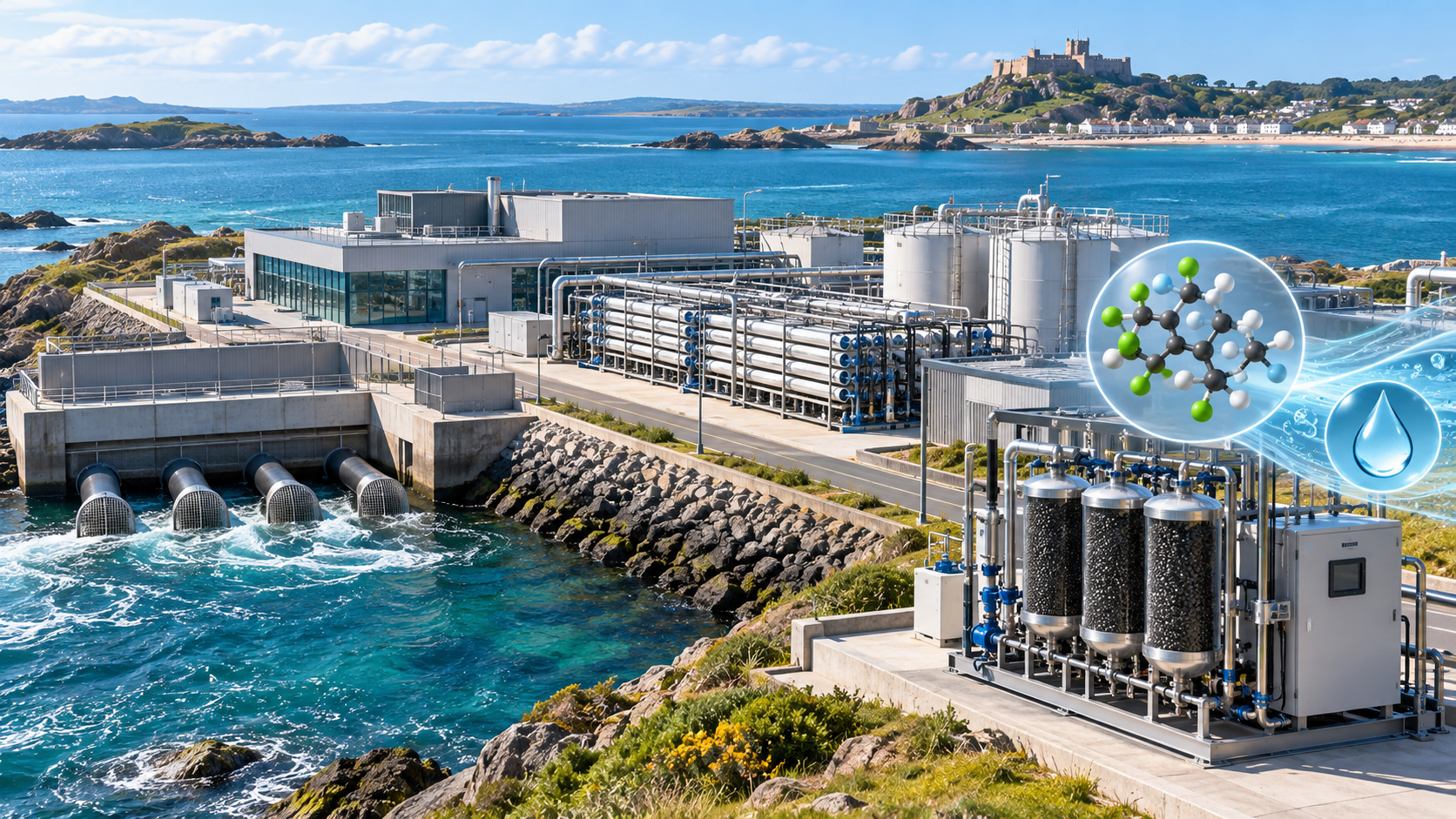
Feature image: ATLAS WTS — Engineering concept illustration. It is a conceptual composite combining coastal desalination with generic PFAS-treatment elements. It does not depict Jersey Water’s actual desalination plant, its PFAS pilot equipment or an integrated process flow. Jersey Water’s public materials describe the desalination upgrade and PFAS treatment trials as separate current workstreams.