
ATLAS Technical Expert Commentary
This case is important because it shows a modular drinking-water expansion built around raw-water deterioration rather than simple demand growth. The selected train of degritting, coagulation, flocculation, dissolved air flotation and continuous upflow sand filtration is well aligned with challenging raw water that carries algae, low-density solids, nutrients and seasonal organics.
The reported process metrics are equally relevant. Low head loss and low water loss improve the life-cycle profile, especially where pumping energy and washwater recovery matter. The more strategic lesson is that modular treatment can shorten delivery time while still using robust conventional unit processes, rather than relying on a purely temporary emergency solution.
News Summary
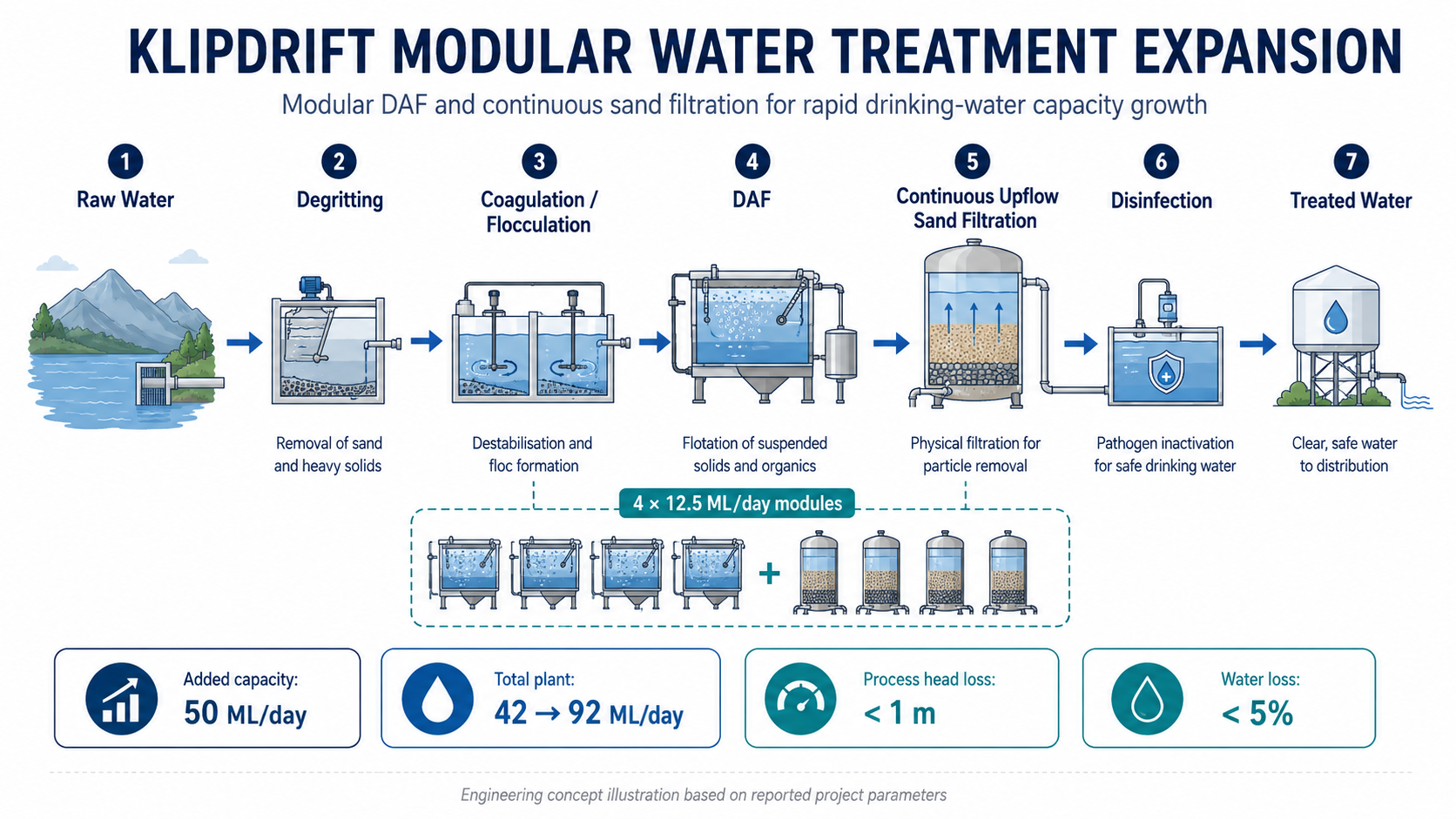
GLOBAL MARKET MONITOR (August 31, 2026) — Magalies Water reported a 50 ML per day expansion at Klipdrift through four 12.5 ML per day modules. The added trains lift total plant capacity from 42 to 92 ML per day. The reported process sequence is raw water intake, degritting, coagulation and flocculation, DAF, continuous upflow sand filtration and disinfection. Published figures also note process head loss below 1 m and total water loss below 5 percent.
Key Points:
- Added capacity is 50 ML per day through 4 × 12.5 ML per day modules.
- Total plant capacity rises from 42 to 92 ML per day.
- DAF and continuous sand filtration were selected for rapid and resilient treatment.
Media & Source: Tracked via Infrastructure News.
Image note: ATLAS original engineering concept illustration created for this article.