
Article Masthead
- Category: Policy & Regulation
- Topic: PFAS / Drinking Water
- Region: North America
- Date: 2026-09-03
- Signal Type: Compliance Infrastructure Signal
01 What Happened
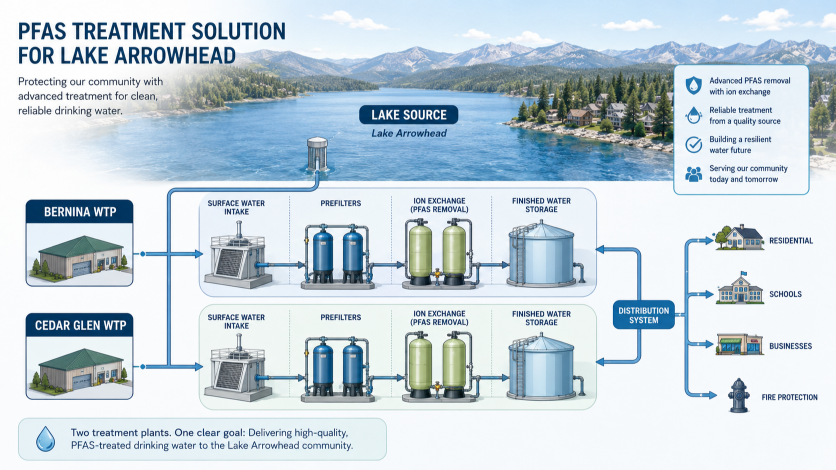
Current Lake Arrowhead Community Services District materials say the preliminary design for PFAS treatment is complete and that the new treatment solution will utilize ion exchange, with final plans still in development. The district also states that EPA final PFAS regulations require treatment by 2029 and that it is working ahead of that deadline. On the water-supply side, Bernina blends lake water, groundwater, and imported water, while Cedar Glen processes one hundred percent lake water. A California state funding document lists the Lake Arrowhead CSD PFAS Removal project at about USD 15.952 million.
02 Key Takeaways
- 01 LACSD says ion exchange has been selected for the new PFAS treatment solution.
- 02 The district reports preliminary design is complete and final plans are in development.
- 03 Bernina and Cedar Glen are both surface-water affected plants, but their source-water profiles are not identical.
- 04 A California state funding document lists the PFAS removal project at about USD 15.952 million.
03 Why It Matters
This matters because PFAS compliance is moving beyond groundwater wellhead projects. Here, the treatment challenge is tied to a lake-influenced supply, where natural organic matter, seasonal quality shifts, and pretreatment interactions can all affect media performance. It also shows how regulatory deadlines are already shaping capital planning for small and mid-sized drinking-water systems.
04 ATLAS Engineering View
Ion exchange is a logical pathway for many PFAS projects, but surface-water service changes the engineering discussion. Pretreatment quality, fouling control, empty-bed contact time, breakthrough behavior, and spent-media management all matter. LACSD’s own current materials also say Lake Arrowhead has shown higher PFAS concentrations than groundwater in its sampling work, which increases the value of source characterization. One boundary is important: public materials do not disclose resin type, vessel count, design loading, or whether any additional barriers will be installed, so those details should not be inferred.