
Article Masthead
- Category: Market Intelligence
- Topic: PFAS Membrane Materials Research
- Region: Middle East
- Signal Type: Emerging Treatment Research
- Published Date: 2026-09-22
- Original Source Date: 2026-09-21
01 What Happened
NYU Abu Dhabi published a research profile on September 21 describing work by Emirati postdoctoral researcher Reham Al Nuaimi on materials that could both capture PFAS and help break them down.
Working in Assistant Professor Safiya Khalil Alhashmi’s lab through the Kawader program, Al Nuaimi is exploring covalent organic frameworks (COFs) — ordered crystalline materials with tunable nanoscale pores. The research direction is to understand how COF chemistry and pore structure can interact with targeted contaminants such as PFAS.
The stated objective goes beyond separation alone. NYU Abu Dhabi says the longer-term direction is to incorporate these materials into synthetic membranes so that a membrane could potentially separate pollutants while also helping to degrade them. The university does not report a commercial PFAS membrane, a full-scale treatment system or proof of complete mineralization; the work remains a research pathway under development.
02 Key Takeaways
01 The research targets a longstanding PFAS problem: conventional treatment often separates PFAS from water but leaves a concentrated residual that still requires management.
02 COFs offer a tunable porous structure that may be engineered for selective capture and, potentially, reaction pathways that help degrade captured PFAS.
03 The development signal is early-stage but strategically important because it points toward membranes that could combine separation and active treatment rather than functioning only as physical barriers.
03 Why It Matters
PFAS treatment is often a transfer problem as much as a removal problem. GAC and ion exchange move PFAS from water onto media; RO/NF move them into concentrate. These technologies can be highly effective for water treatment, but they create spent media or concentrated residual streams that must still be managed.
A material that can capture PFAS and then participate in their degradation could change that boundary. Instead of optimizing only rejection or adsorption capacity, membrane research could begin to optimize capture, reaction environment, catalyst stability, by-product formation and regeneration together.
The key uncertainty is the word could. PFAS degradation is chemically difficult because the carbon-fluorine framework is highly persistent. Moving from promising material behavior to a practical water-treatment process requires evidence on kinetics, transformation products, energy or reagent demand, membrane lifetime, fouling and performance in real water matrices.
04 ATLAS Engineering View
ATLAS sees the most important engineering opportunity in coupling separation with destruction, but that claim must be validated through mass balance rather than inferred from parent-compound disappearance.
For any future COF-enabled PFAS membrane, a credible engineering assessment would need to answer several questions: Which PFAS are captured? What fraction is actually degraded? What fluorinated intermediates are produced? Is fluoride release measurable? Does the COF remain stable? How does natural organic matter affect performance? Can the material be regenerated? What happens when the membrane reaches end of life?
The current NYU Abu Dhabi story does not answer those questions, and it should not be presented as if it does. What it provides is a useful research signal: membrane science is moving toward multifunctional materials that may eventually reduce the gap between PFAS separation and PFAS destruction.
05 Sources
- NYU Abu Dhabi — Filtering the Future For Cleaner Water — September 21, 2026
- U.S. EPA — PFAS Explained
Image Source and Usage Notice
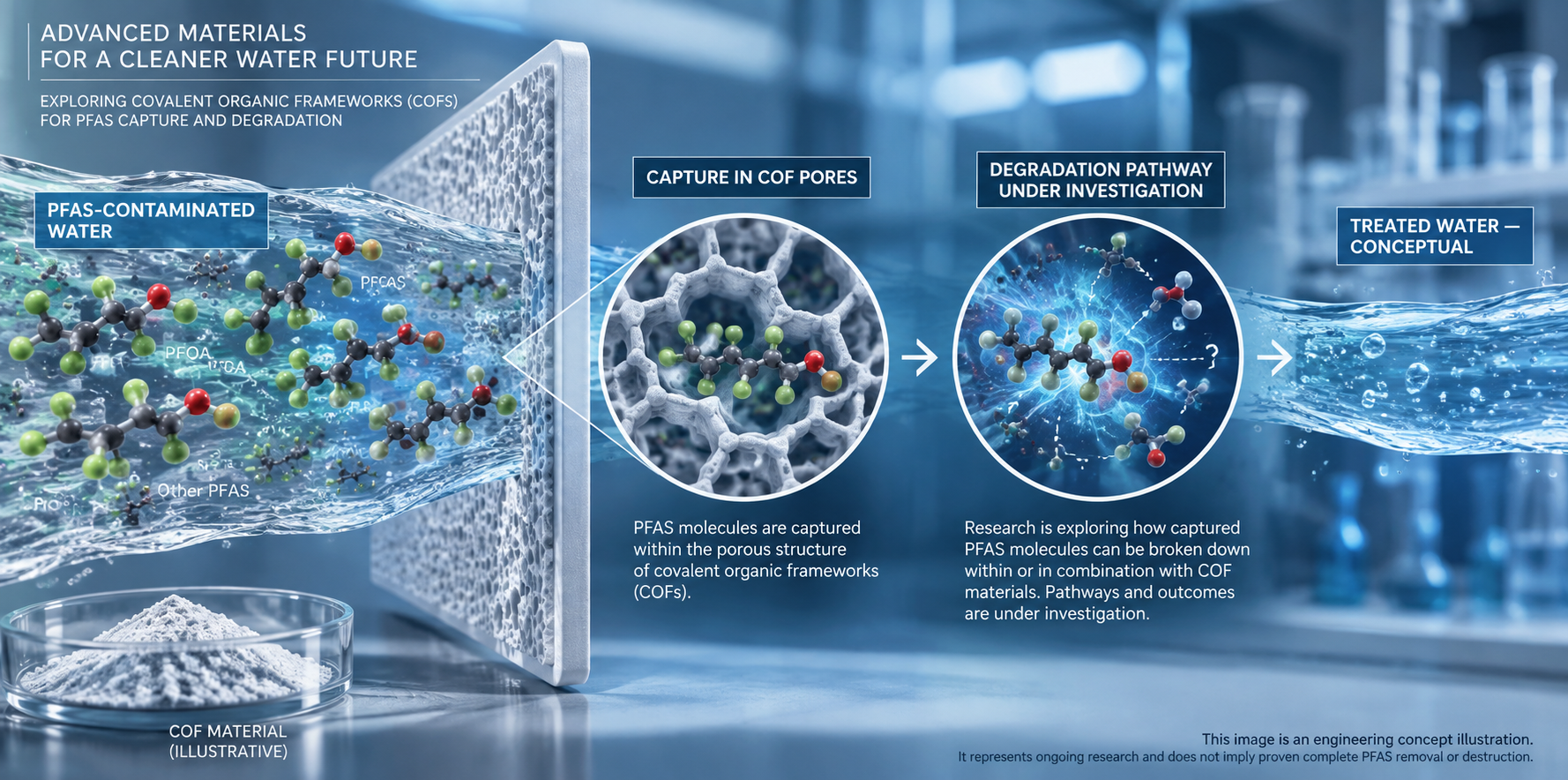
Feature image: ATLAS WTS — Engineering concept illustration. It was created specifically for this article to visualize the research idea of COF-based PFAS capture and a degradation pathway under investigation.
The illustration is not an NYU Abu Dhabi laboratory photograph, does not reproduce the exact experimental apparatus, and must not be interpreted as proof of complete PFAS destruction or production of harmless end products. The scientific claims in the article are limited to what NYU Abu Dhabi publicly reported.