Article Masthead
- Category: Capital Projects & Infrastructure
- Topic: SWRO Marine Infrastructure
- Region: Asia-Pacific
- Signal Type: Construction Milestone
- Published Date: 2026-09-08
- Original Source Date: 2026-09-08
01 What Happened
ACCIONA reported on September 8 that the Alkimos Seawater Alliance has completed two undersea tunnels for Western Australia’s AUD 2.8 billion Alkimos Seawater Desalination Plant program. Water Corporation had announced the marine milestone on September 1 after about 15 months of continuous tunnelling beneath the seabed.
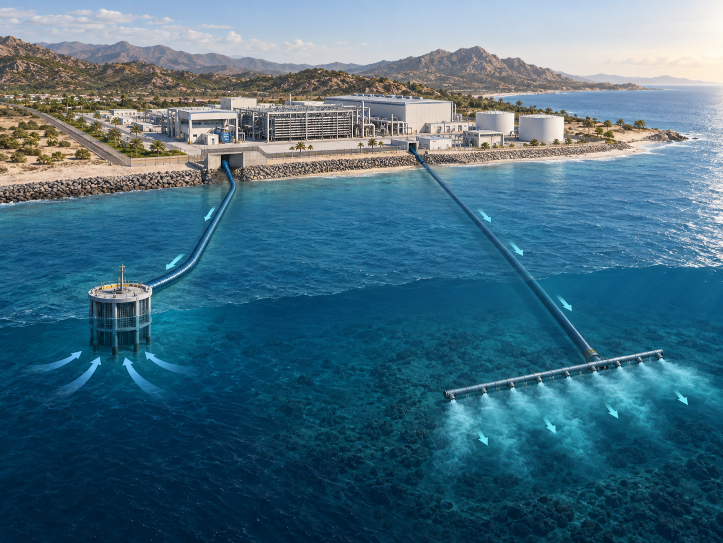
The project uses separate marine tunnels for seawater intake and brine outfall. Water Corporation lists the intake tunnel at about 2.5 km and the outfall tunnel at about 4 km. Offshore structures sit about 1.6 km and 3 km from shore respectively. A roughly 130 m outfall diffuser with 20 ports will release reverse-osmosis concentrate back to the ocean.
Stage 1 is planned to supply about 50 billion litres of drinking water each year, equivalent to roughly 150,000 m³/d. The marine infrastructure has been sized for a future Stage 2 expansion that could double total production to about 300,000 m³/d. First water production remains planned for 2028.
This milestone does not mean the desalination plant is commissioned. Mechanical and electrical fit-out, onshore treatment works, the 33.5 km transfer pipeline and other works remain in progress. The significance is that one of the project’s most difficult marine-construction packages has moved from tunnelling into connection, inspection and commissioning work.
02 Key Takeaways
01 More than 6 km of undersea intake and outfall tunnels have been completed.
02 Stage 1 is designed for roughly 150,000 m³/d, while marine infrastructure has been future-proofed for a possible doubling of capacity.
03 The milestone shows that intake hydraulics, brine outfall and marine construction can be as important to large SWRO projects as the membrane plant itself.
03 Why It Matters
Desalination discussions often focus on membrane recovery, specific energy consumption and product-water quality. At large scale, however, the plant cannot perform without a reliable connection to the ocean.
Intake design controls how seawater reaches pretreatment. Poor intake hydraulics can increase entrainment, sediment loading, biofouling risk and pumping energy. Outfall design determines how concentrate returns to the receiving environment. Diffuser geometry, discharge velocity, ambient currents, water depth and local bathymetry all influence initial dilution and near-field salinity.
Alkimos also illustrates why future expansion must be considered early. Enlarging a membrane building later is difficult but usually feasible. Retrofitting offshore tunnels, risers and diffusers after the coastal system is operating can be far more disruptive and expensive.
The engineering lesson is that desalination reliability depends on the entire source-to-distribution chain: marine structures, pretreatment, RO trains, post-treatment, power supply and bulk conveyance.
04 ATLAS Engineering View
From an ATLAS engineering perspective, the most important feature is the separation of intake and concentrate-discharge functions and the way the marine system has been designed around environmental performance and future hydraulic capacity.
The reported 130 m outfall diffuser with 20 ports is particularly important. A diffuser does not make brine disappear; it creates controlled mixing so concentrate can dilute rapidly in receiving water. Actual performance depends on operating flow, concentrate salinity, port configuration, currents and ecological sensitivity. Public data are insufficient to calculate dilution performance, so none should be inferred.
The intake deserves equal attention. Water Corporation says two roughly 12 m-wide intake structures will sit about 1.6 km offshore and seawater will enter slowly and steadily. Low approach velocity is generally desirable, but final performance still depends on screening, hydraulic losses, maintenance access and seasonal marine conditions.
A municipal SWRO plant should not be treated as a membrane skid scaled up. At this scale, the ocean interface is a major process boundary and deserves the same engineering rigor as pretreatment and reverse osmosis.
05 Sources
- ACCIONA — Undersea tunnels completed for Alkimos Seawater Desalination Plant — September 8, 2026
- Water Corporation — Alkimos Desalination Plant marks marine milestone — September 1, 2026
- Water Corporation — Alkimos Seawater Desalination Plant
- Water Corporation — Alkimos construction update
Image Source and Usage Notice
The feature image is an original ATLAS engineering concept illustration. It is provided as an illustrative visual to explain marine intake and brine outfall infrastructure and should not be interpreted as a photograph of the Alkimos project site.
- Credit: ATLAS Engineering concept illustration
Publication Note
ATLAS should preserve the stated credit line and source/license references when publishing. License information is recorded based on the source page reviewed at the time of writing; final publication remains the publisher’s responsibility.