Article Masthead
- Category: Capital Projects & Infrastructure
- Topic: Island Desalination and Water Security
- Region: Asia-Pacific
- Signal Type: Desalination Project Tender
- Published Date: 2026-09-21
- Original Source Date: September 2026
01 What Happened
Australia is advancing a permanent seawater reverse-osmosis plant for the Cocos (Keeling) Islands, with the tender for the project issued through the Western Australian Water Corporation.
The project will deliver a new 200 kL/day SWRO plant for the West Island community water supply. According to the Australian Government, the permanent plant is planned to be operational in 2027.
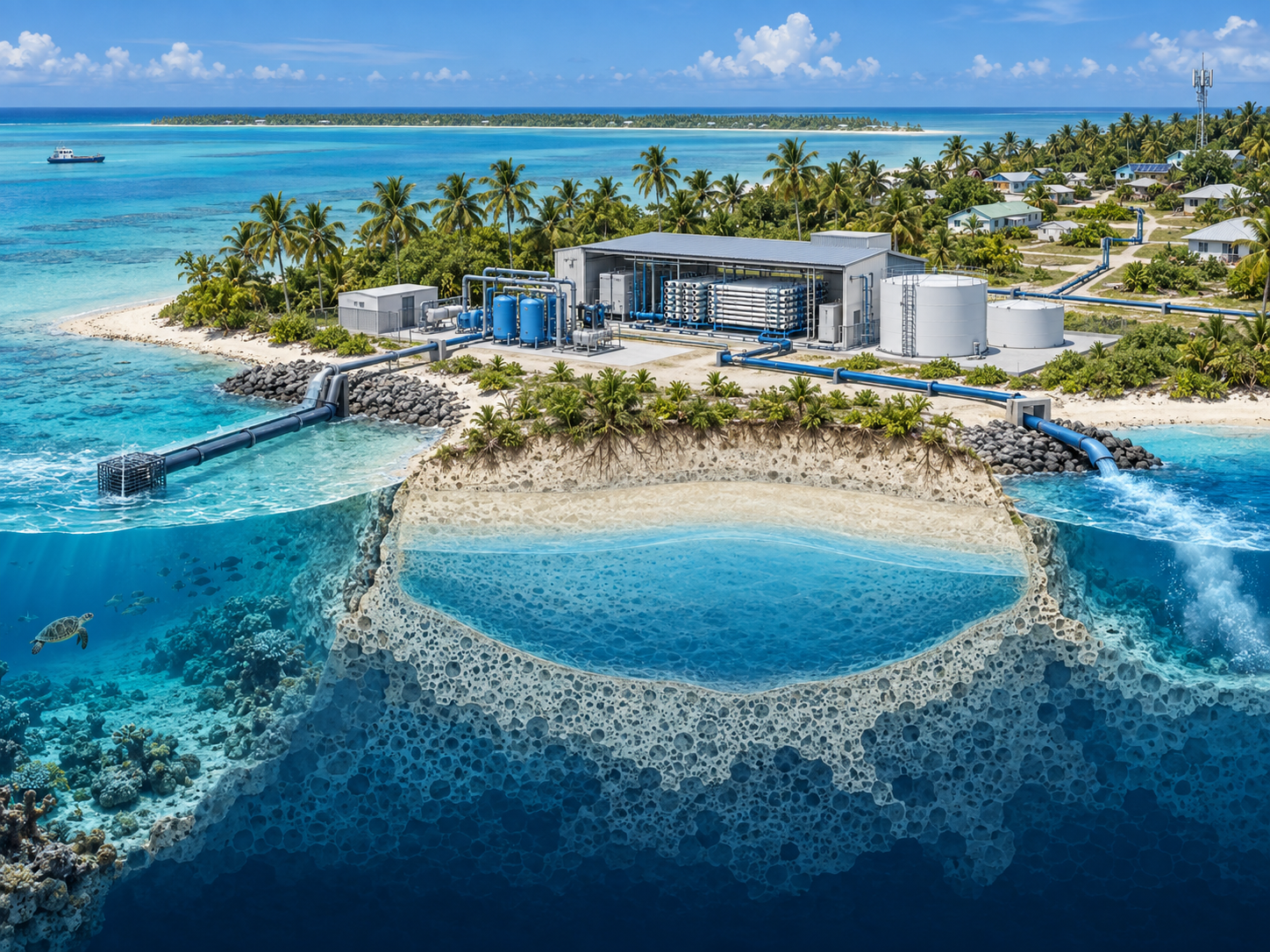
The new facility will be located next to the existing wastewater treatment plant on Sydney Highway. Its purpose is to replace reliance on the freshwater lens located beneath the operating airfield, providing a more secure community water source and supporting future economic development.
The project scope includes the permanent SWRO facility and bores that will supply seawater to the plant.
A temporary SWRO system is also being developed separately in coordination with the Department of Defence. That temporary system is intended to support a Defence runway project and is expected to be installed before the permanent plant.
02 Key Takeaways
01
The permanent plant is sized at 200 kL/day and is intended primarily for West Island community supply.
02
Its strategic purpose is not only additional capacity: it is designed to replace dependence on a vulnerable freshwater lens beneath an active airfield.
03
The permanent project has moved into tendering, while a separate temporary SWRO system will support near-term Defence infrastructure works.
04
The project illustrates how small-island desalination can function as source-water protection as well as new supply development.
03 Why It Matters
Small islands often have very limited freshwater storage. A freshwater lens can be sensitive to abstraction, drought, saltwater intrusion, contamination and changes in land use.
When the lens lies beneath an operating airfield, long-term water planning also has to consider infrastructure access, contamination risk and operational constraints.
SWRO changes the source-water strategy by shifting community supply toward an effectively unlimited seawater source. That does not make the project simple. Island desalination must still manage energy use, intake reliability, membrane pretreatment, brine disposal, chemical supply, spare parts and operator capability.
For a remote island community, reliability can matter as much as unit production cost. Equipment redundancy, storage, emergency operation and logistics can therefore become major design factors even for a relatively small 200 kL/day plant.
04 ATLAS Engineering View
From an engineering perspective, the most important feature of this project is the source transition.
The objective is not merely to add an SWRO skid. The system is being used to reduce long-term dependence on a vulnerable groundwater lens, which changes how reliability and environmental performance should be evaluated.
Pretreatment requirements will depend on the actual intake arrangement and seawater quality. A robust small-island SWRO system may need screening, cartridge filtration and, depending on local conditions, additional pretreatment to control suspended solids, biological fouling and membrane scaling.
The concentrate-discharge arrangement also deserves careful attention. At small scale, brine volume is lower than at major desalination plants, but discharge location, mixing, nearshore ecology and maintenance access remain important.
Because the site is remote, chemical availability, replacement membranes, pumps, instrumentation and trained operators can become critical reliability constraints. Water storage and contingency planning should therefore be considered part of the treatment system rather than separate operational details.
The broader engineering lesson is that island desalination projects should be assessed not only by cost per cubic metre, but by the value of replacing a stressed or vulnerable freshwater source with a more controllable supply.
05 Sources
Image Source and Usage Notice
ATLAS-created engineering concept illustration. It is not documentary photography of the specific project or an owner-issued engineering drawing.
- Credit: ATLAS WTS — Engineering concept illustration