Article Masthead
- Category: Technology
- Topic: Biosolids / Supercritical Water Oxidation
- Region: North America
- Signal Type: Factory Test / Pending Deployment
- Published Date: 2026-11-25
- Original Source Date: 2026-11-25
01 What Happened
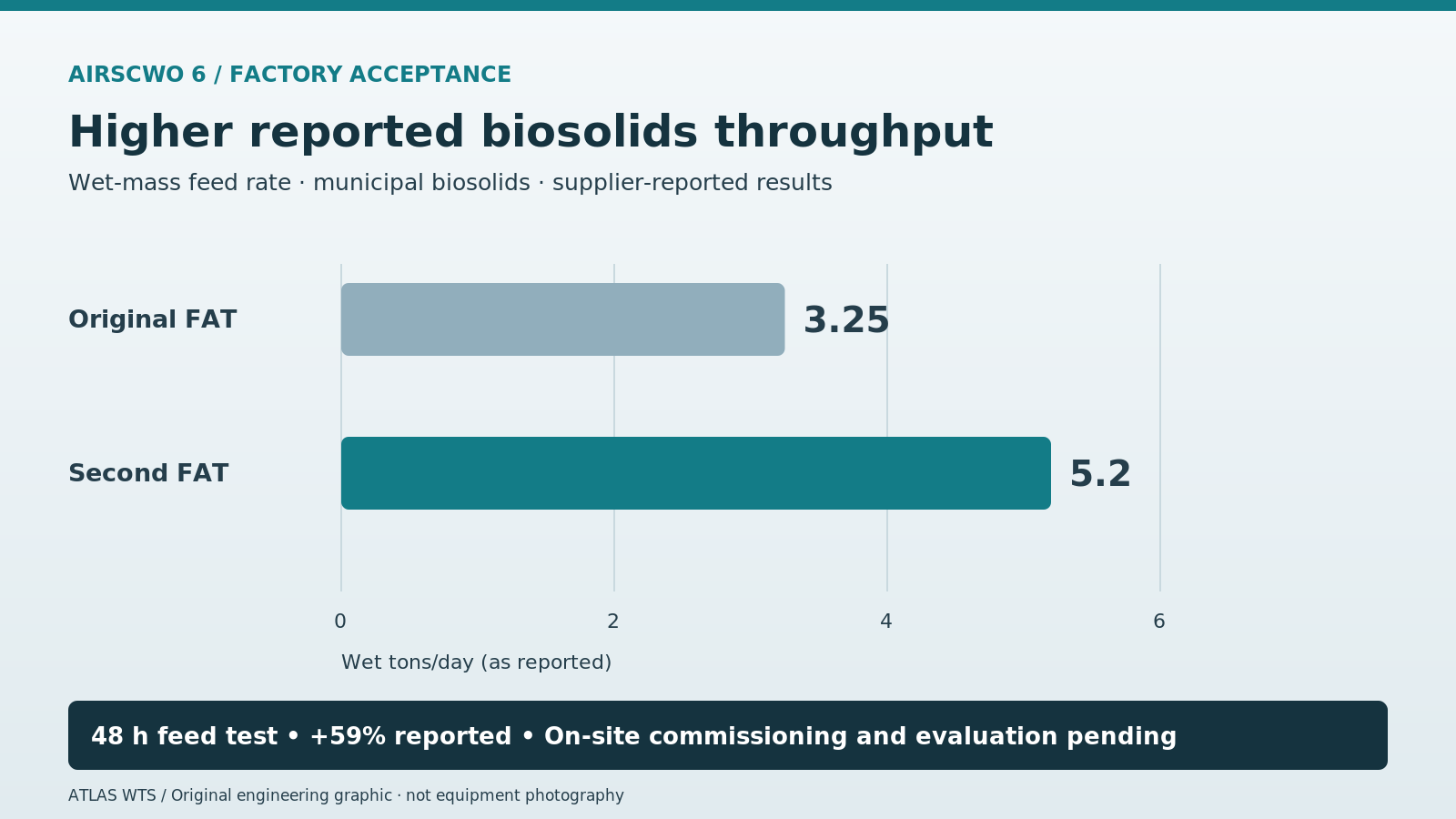
On November 25, 2026, 374Water reported completion of a second factory acceptance test (FAT) of its AirSCWO 6 system for Orange County Sanitation District (OC San), California. The voluntary test took place at its facility at Orlando’s Iron Bridge Water Reclamation Facility. Using municipal biosolids, the upgraded unit averaged 5.2 wet tons/day over 48 hours of feeding, versus 3.25 wet tons/day in the earlier accepted test. The company reported a 59% increase without enlarging the equipment footprint; the rounded rates imply approximately 60%. The unit and its companion dewatering equipment are expected to leave Orlando in the week beginning November 30, 2026. Installation, commissioning and testing at OC San Plant No. 1 are still pending.
The source reports wet tons; no metric-tonne conversion is assumed.
02 Key Takeaways
01 The second FAT is a supplier-reported factory milestone, not site acceptance.
02 Throughput increased from 3.25 to 5.2 wet tons/day in the reported tests.
03 Shipment is planned, not confirmed. The announcement does not establish PFAS destruction efficiency for this biosolids run.
03 Why It Matters
Supercritical water oxidation (SCWO) uses oxidation under conditions above water’s critical point to break down organic material. It offers a potential alternative to conventional biosolids disposal, but wet feed throughput alone cannot establish treatment cost or environmental performance. Feed moisture and organic content determine the actual dry-solids and organic loading.
04 ATLAS Engineering View
For a field evaluation, ATLAS would compare dry-solids throughput, energy per unit of dry solids, uptime, corrosion, salt deposition, residual handling and the quality of liquid and gaseous outputs. PFAS performance requires a separate analytical program, including feed and output measurements, fluorine balance and detection limits. No plant-wide capacity or long-term operating cost can be inferred from a 48-hour factory test.
05 Sources
- 374Water / ACCESS Newswire — company announcement, 2026-11-25
- Proactive Investors — second factory test, 2026-11-25
- U.S. Army ERDC — separate AFFF demonstration report notice
Image Source and Usage Notice
Original ATLAS WTS engineering illustration. No third-party photo is redistributed. Original engineering graphic comparing the two reported wet-biosolids feed rates; not a photograph or a vendor performance guarantee.