
Article Masthead
- Category: Projects
- Topic: Drinking-Water Disinfection / Inherently Safer Design
- Region: North America
- Signal Type: Capital Project / Process Safety Conversion
- Published Date: 2026-10-14
01 What Happened
Austin’s Water and Wastewater Commission is reviewing on October 14, 2026 a recommendation for the Ullrich Water Treatment Plant Inherently Safer Disinfection Conversion.
The proposed construction contract with MGC Contractors is USD 81,555,085, with an USD 8,155,509 contingency, for a total amount not to exceed USD 89,710,594. The item is scheduled to move to Austin City Council on October 22; the October 14 commission review is therefore not the final construction authorization.
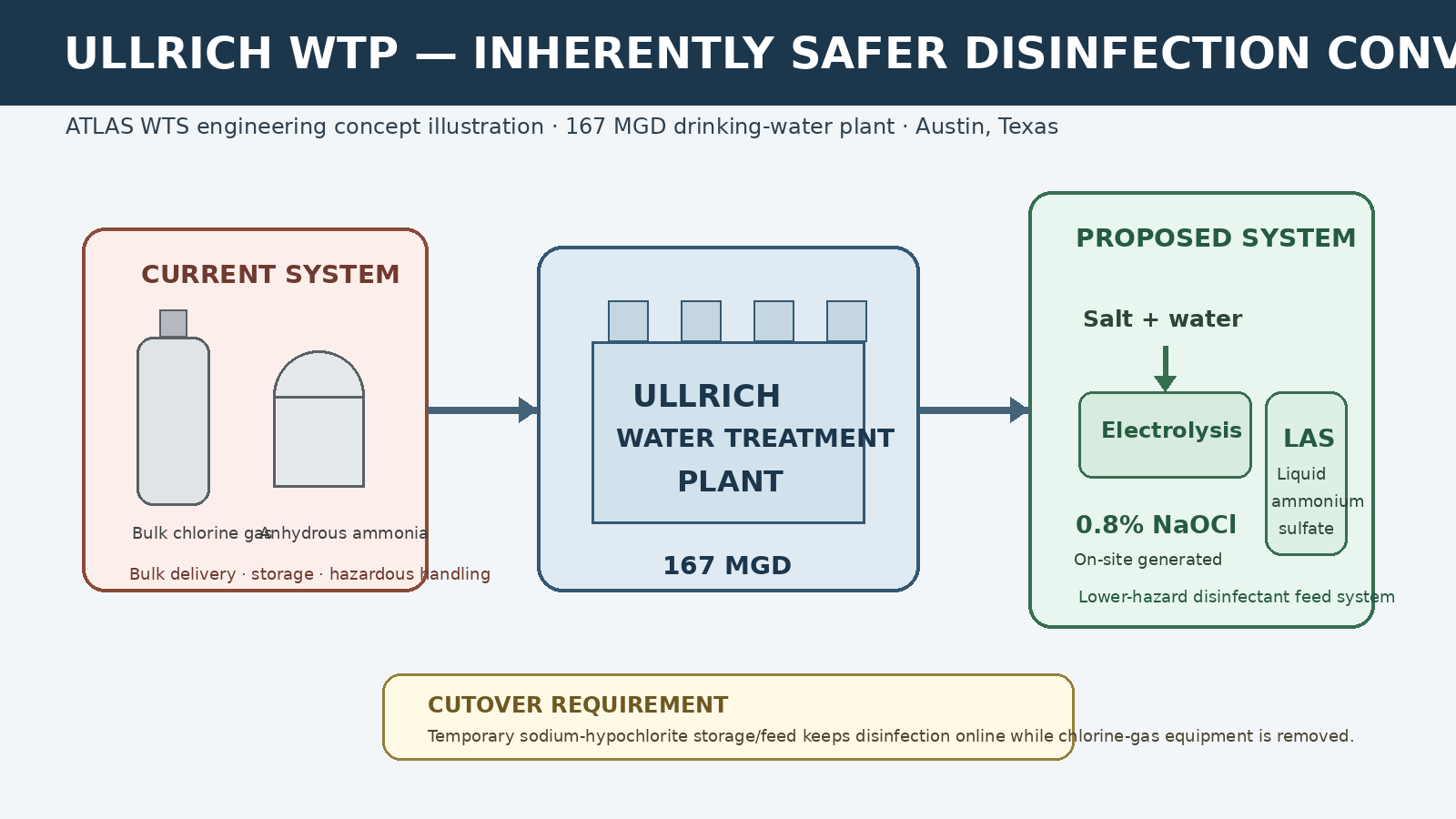
Ullrich is Austin Water’s largest drinking-water plant, with a rated capacity of 167 MGD. It currently uses gaseous chlorine and anhydrous ammonia, requiring bulk delivery, storage and handling of hazardous chemicals.
The project would replace those systems with on-site generated sodium hypochlorite (OSGSH) and liquid ammonium sulfate (LAS). Austin’s project documents state that the OSGSH system will use electrolysis of salt and water to produce approximately 0.8% sodium hypochlorite. LAS will provide ammonia in a liquid, lower-hazard form for chloramine formation.
A key construction requirement is continuous plant operation. Austin plans to use a temporary sodium-hypochlorite storage and feed system while the existing chlorine-gas system is demolished and the new OSGSH equipment is installed.
02 Key Takeaways
01 The proposed construction authorization is capped at USD 89.71 million, including contingency.
02 The project replaces bulk chlorine gas and anhydrous ammonia with 0.8% on-site generated sodium hypochlorite and LAS.
03 The safety benefit comes primarily from eliminating routine storage and handling of two hazardous bulk gases at a major drinking-water plant.
04 The conversion must be executed without losing disinfection capability; a temporary hypochlorite system is part of the cutover strategy.
03 Why It Matters
This project is significant because it treats chemical-process safety as part of drinking-water infrastructure, not as a separate operational issue.
Gaseous chlorine is effective and widely understood, but accidental release can create an off-site hazard. Anhydrous ammonia also requires specialized bulk storage and handling. Moving to low-strength, on-site sodium-hypochlorite generation reduces the inventory of concentrated chlorine-bearing material, while LAS avoids bulk anhydrous-ammonia handling.
The change does not eliminate the need for precise disinfection control. Chloramine performance still depends on chlorine-to-ammonia ratio, pH, contact time, water temperature and distribution-system conditions. A safer chemical form must therefore be integrated with the same water-quality discipline as the existing system.
04 ATLAS Engineering View
ATLAS sees the project as a useful example of inherently safer design applied to municipal water treatment.
The engineering value is not simply “switching chemicals.” The plant must coordinate salt supply, electrolytic generation capacity, hypochlorite storage turnover, LAS metering, redundancy, instrumentation, ventilation, secondary containment and emergency operating modes.
The temporary feed system is especially important. At a 167 MGD plant, disinfection cannot be treated as a construction shutdown item. The transition sequence must preserve CT requirements and distribution-system disinfectant residual while old equipment is removed and new equipment is commissioned.
For other utilities evaluating similar conversions, the decision should compare total lifecycle risk and cost: hazardous-material transport, regulatory burden, operator exposure, chemical degradation, electrical demand, salt logistics, maintenance, redundancy and water-quality performance.
05 Sources
- Austin Water and Wastewater Commission — Item 05, October 14, 2026
- City of Austin — Ullrich Water Treatment Plant Upgrades
- City of Austin — Facilities
- U.S. EPA — Basic Information about Chloramines and Drinking Water Disinfection
Image Source and Usage Notice
Feature image: ATLAS WTS — Engineering concept illustration. Created specifically for this news package from the publicly described project scope. It is not an Ullrich project photograph, P&ID, process-flow diagram, equipment submittal, or owner-issued design drawing.