
Article Masthead
- Category: Market Intelligence
- Topic: Desalination / Water Security
- Region: Asia-Pacific
- Signal Type: Water Security Signal
- Published Date: 2026-09-04
- Original Source: The Freeman
01 What Happened
The Metropolitan Cebu Water District is positioning desalination as part of its long-term water-supply strategy as the island faces continuing pressure on groundwater resources and rising urban demand.
The Freeman reported on September 4 that desalinated water has been entering the MCWD system since July at an initial rate of 5,000 m³/d, or 5 MLD. The supply comes from Isla Mactan Cordova Corporation’s desalination facility in Cordova and is being delivered under a commitment to provide 20,000 m³/d, or 20 MLD, to Metro Cebu. Vivant, the parent company of the project developer, said on September 3 that the initial 5 MLD now reaches Lapu-Lapu City and communities across Mactan Island.
The current 5 MLD flow is therefore not the full design commitment. According to Vivant, the supply is intended to increase in phases as intake systems are further stabilized. At the full committed volume of 20 MLD, the company says the facility is expected to support close to 30,000 households.
The desalination arrangement is tied to a 25-year joint venture agreement between MCWD and Vivant Water. Vivant said in 2025 that its Cordova plant can produce up to 20 million liters of potable water per day. The September 4 reporting also frames desalination as part of a broader effort to reduce dependence on groundwater, which has long been a major source for Cebu. The Freeman reported that continued over-extraction has contributed to saltwater intrusion and declining groundwater levels.
The current news event is therefore not the commissioning of a brand-new desalination plant on September 4. The plant and partnership predate this week. The new signal is that desalinated water is now being integrated into MCWD’s distribution system and is being presented by the utility and project partners as part of a longer-term water-security strategy.
02 Key Takeaways
01 MCWD is currently receiving about 5 MLD of desalinated water, with supply intended to rise toward a 20 MLD commitment. 02 The new supply is being integrated into Lapu-Lapu City and Mactan Island distribution while Cebu continues to face groundwater stress. 03 Desalination is being used as a diversification measure, but aquifer recovery would still depend on whether groundwater abstraction is actually reduced over time.
03 Why It Matters
Cebu is a useful example of why desalination projects should be evaluated as part of a water portfolio rather than as isolated treatment plants. A coastal city can add technically reliable seawater treatment capacity and still remain vulnerable if groundwater extraction, distribution losses, storage constraints, and peak demand are not managed together.
The 20 MLD commitment is meaningful because it creates a water source that does not depend on the same aquifers already under pressure. In principle, each cubic meter of desalinated water that replaces groundwater demand can reduce the need for pumping from stressed wells. That matters in coastal aquifers because persistent over-abstraction can lower freshwater heads and increase the hydraulic conditions that favor saltwater intrusion.
The practical value of desalination therefore depends on how the new water is incorporated into the broader system. If the 20 MLD supply is used mainly to satisfy additional growth while groundwater pumping remains unchanged, the aquifer-relief benefit may be limited. If it allows MCWD and other users to reduce abstraction from vulnerable groundwater sources, the strategic value is much larger.
This distinction is important for other fast-growing coastal cities. Desalination can add drought-resistant supply, but the strongest water-security benefit comes when it is integrated with demand management, groundwater controls, storage, network reliability, and other sources rather than treated as a stand-alone answer.
04 ATLAS Engineering View
From an engineering perspective, the most important question is not whether seawater reverse osmosis can produce potable water in Cebu. Utility-scale SWRO is already a mature treatment route. The more important question is what role that product water plays in the regional water balance.
The reported 5 MLD initial delivery and 20 MLD committed volume should be viewed against the system’s source portfolio. Desalinated water has a different risk profile from groundwater: it is less dependent on aquifer recharge, but it introduces its own requirements for seawater intake reliability, pretreatment, membrane operation, energy supply, corrosion control, remineralization, and brine management. Those trade-offs are normal for SWRO and should be evaluated at portfolio level rather than used as arguments for or against desalination in isolation.
The aquifer angle also needs discipline. It is reasonable to say desalination can reduce pressure on groundwater because it creates an alternative source. It is not reasonable to say the aquifer will automatically recover simply because 5 or 20 MLD of desalinated water enters the network. Recovery would depend on actual reductions in pumping, local hydrogeology, recharge, well distribution, coastal hydraulic gradients, and the time required for the aquifer system to respond.
For ATLAS, Cebu’s broader lesson is that desalination becomes more valuable when its objective is defined clearly. If the objective is only “add more water,” capacity is the headline. If the objective is “improve long-term water security,” then the engineering metric should include how much stressed groundwater demand is displaced, how much system resilience is gained, and whether the new source can remain reliable through climate variability, peak demand, and operational disruptions.
05 Sources
- The Freeman — Desalination part of MCWD’s long-term plan — September 4, 2026
- Vivant — New OPAV Chief joins Vivant Water tapping as Cebu strengthens water security — September 3, 2026
- Vivant — MCWD boosts water supply with Vivant desal plant partnership — July 1, 2026
- Vivant — 20 MLD desalination plant partnership with MCWD — April 10, 2025
Image source and license
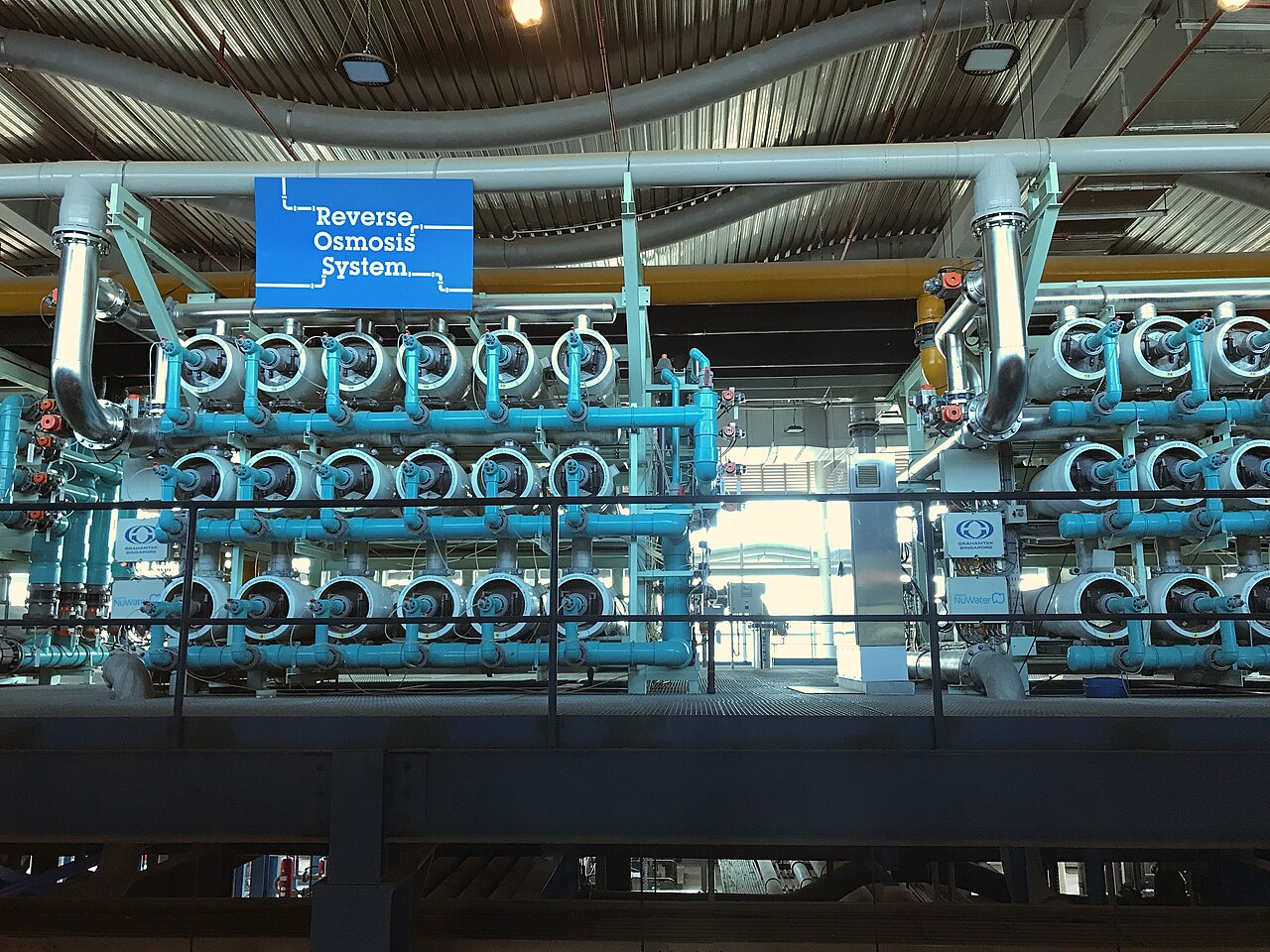
The feature image is not a photograph of the Cebu desalination project. It shows a reverse osmosis system at Bedok NEWater Factory in Singapore and is used as an illustrative membrane-system image.
- Photo: Z22
- Source: Wikimedia Commons
- License: Creative Commons Attribution-ShareAlike 4.0 International
- Reuse condition: attribution is required. If the image is cropped, resized with creative changes, annotated, or otherwise modified, the modification should be indicated and the adapted image must remain under CC BY-SA 4.0 or a compatible license.
