Article Masthead
- Category: Projects
- Topic: Seawater Reverse Osmosis / Conveyance
- Region: Middle East
- Signal Type: Financing Progress / Planned Infrastructure
- Published Date: 2026-11-25
- Original Source Date: 2026-11-19
01 What Happened
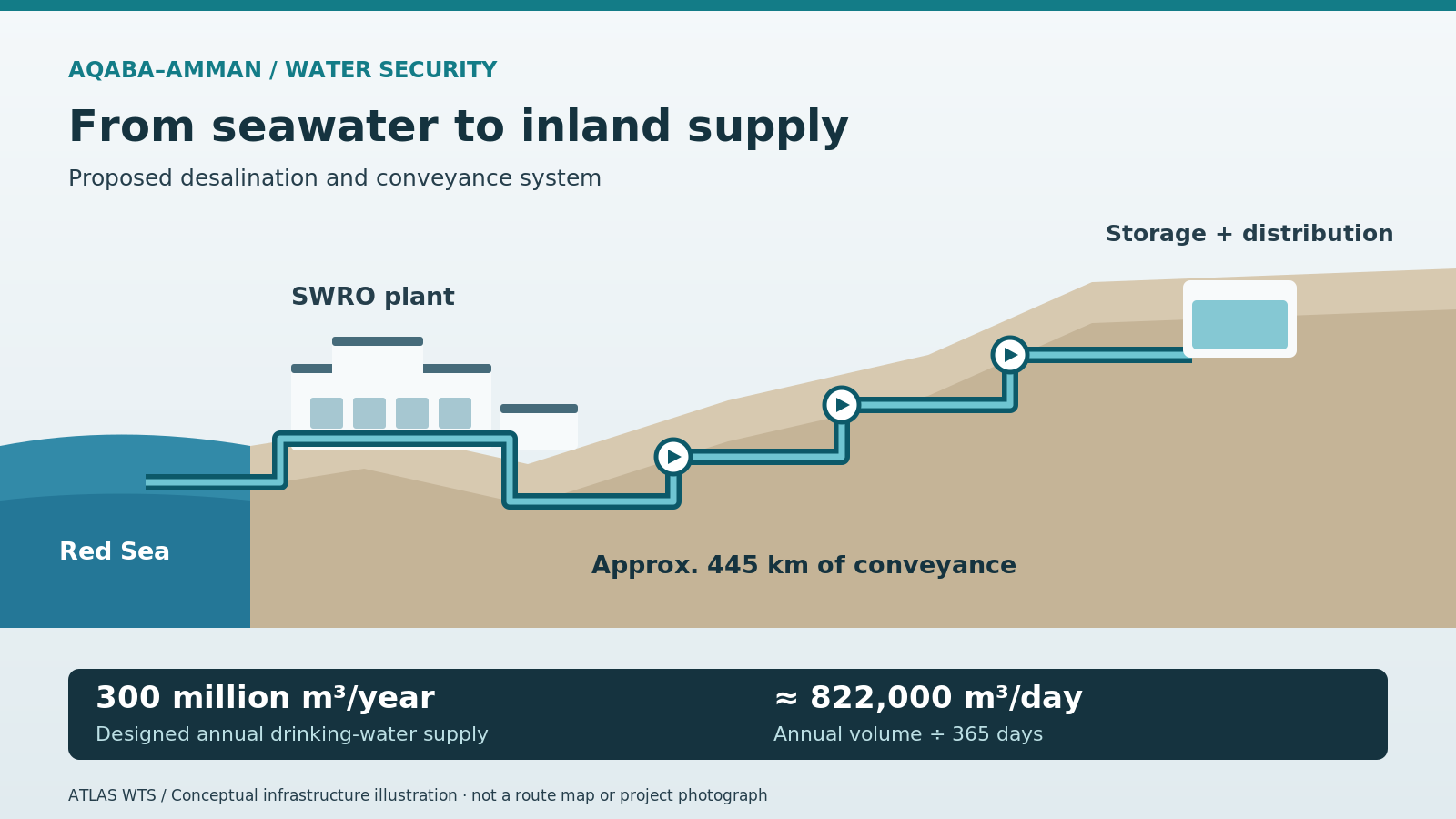
On November 19, 2026, the European Investment Bank (EIB) announced progress on financing the Aqaba–Amman Water Desalination and Conveyance Project. The bank is finalising a USD 400 million project-finance loan backed by an EU guarantee. It would complement an existing EUR 300 million sovereign loan and EUR 127 million in grant support managed by the EIB. The planned Red Sea seawater reverse osmosis (SWRO) plant and approximately 445 km of conveyance infrastructure are designed to deliver 300 million m³/year of drinking water. The EIB expects the scheme to meet around 40% of Jordan’s future water needs. A separate non-binding letter of intent outlines up to EUR 200 million of financing and a proposed EUR 50 million EU grant for complementary distribution readiness infrastructure. The latter is expected to be implemented in 2027–2030; financing remains subject to approvals and contractual processes.
02 Key Takeaways
01 The planned SWRO and conveyance system links coastal water production to inland demand.
02 The design output of 300 million m³/year corresponds to about 822,000 m³/day averaged over 365 days, not necessarily the installed daily capacity.
03 The USD 400 million loan is being finalised; the separate readiness financing is not a binding commitment.
03 Why It Matters
Desalination capacity alone does not deliver water to consumers. Long-distance transfer, pumping, storage and connection to existing distribution networks are essential. Jordan’s new supply may reduce pressure on groundwater, but its actual contribution depends on utilisation, reliability and delivered water cost.
04 ATLAS Engineering View
ATLAS would assess the plant and conveyance system together: seasonal seawater quality, pretreatment, membrane recovery, brine discharge, energy recovery, pumping head, transient pressures, reservoir sizing and network interfaces. The published annual output is useful for water-balance screening, but the announcement does not specify installed train capacities, total dynamic head or specific energy consumption. Those quantities must not be assumed from pipeline length alone.
05 Sources
Image Source and Usage Notice
Original ATLAS WTS engineering illustration. No third-party photo is redistributed. Original conceptual illustration of coastal SWRO production and inland water conveyance. Not a project map, photograph or owner-issued design.