Article Masthead
- Category: Projects
- Topic: Wastewater Reuse / Resource Recovery / PPP Infrastructure
- Region: Middle East
- Signal Type: Industry Recognition / Operating Infrastructure
- Published Date: 2026-10-16
01 What Happened
Kuwait’s Umm Al Hayman for Wastewater Treatment Company K.S.P.C. received the Sustainable Water Infrastructure Award — Kuwait and Water Treatment Excellence Award — Kuwait at the Asian Water Awards 2026, announced on October 16, 2026.
The recognition concerns an operating wastewater and reuse system, not a newly commissioned plant. Umm Al Hayman has an initial average treatment capacity of 500,000 m³/d, serves about 1.7 million people in southern Kuwait and provides for future expansion to 700,000 m³/d.
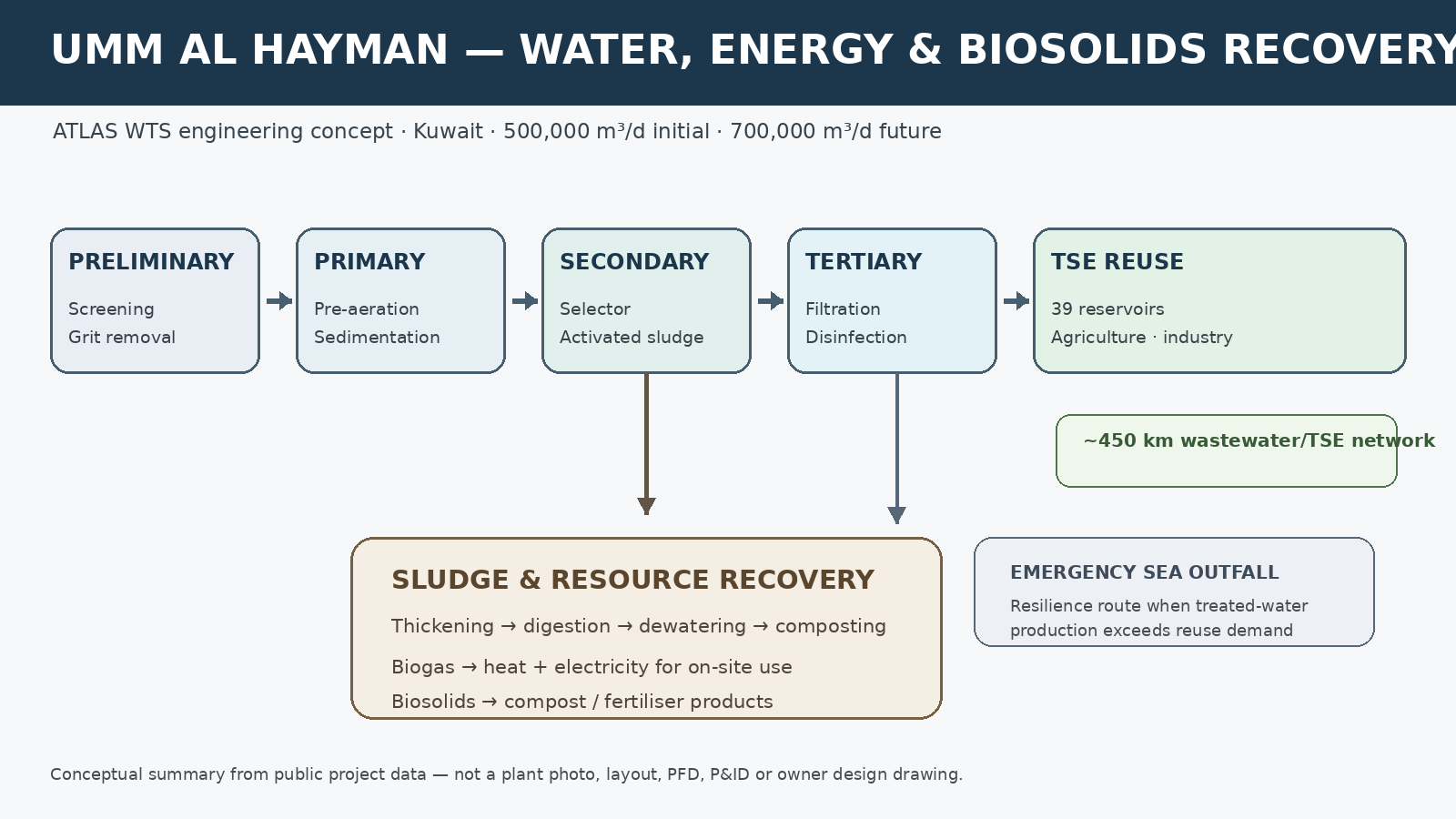
Official project information describes preliminary treatment, primary treatment, activated-sludge secondary treatment, and tertiary filtration and disinfection. Treated Sewage Effluent (TSE) is directed into a reuse system rather than relying on sea discharge as the normal destination.
The wider project includes about 450 km of wastewater and TSE pipelines and 39 TSE reservoirs, each with storage capacity from 2,000 m³ to 160,000 m³. Reclaimed water is intended for agricultural, landscaping, industrial and other non-potable uses.
Sludge is thickened, digested, dewatered and composted. Biogas from digestion is converted to heat and electricity for on-site use, while biosolids can be processed into compost and fertiliser products.
02 Key Takeaways
01 The 2026 awards recognise an integrated operating system, not a newly announced plant.
02 Initial treatment capacity is 500,000 m³/d, with provision for 700,000 m³/d.
03 About 450 km of pipelines and 39 TSE reservoirs connect treatment capacity to actual reuse demand.
04 The resource-recovery chain combines reclaimed water, biogas-to-energy and biosolids processing.
03 Why It Matters
The engineering significance is the scale of integration. Producing tertiary effluent is only the first step; beneficial reuse also requires transmission, storage, demand matching and operational control.
In a country where potable supply depends heavily on desalination, using TSE for suitable agricultural, landscaping and industrial demands can avoid using high-value desalinated water where drinking-water quality is unnecessary.
The sludge line adds another circular pathway. Anaerobic digestion turns sludge into an energy-bearing intermediate, while further biosolids processing reduces the final residual stream.
The emergency sea outfall remains a resilience element because reclaimed-water production and customer demand will not always match in real time.
04 ATLAS Engineering View
ATLAS views Umm Al Hayman as a water-reuse system, not merely a wastewater treatment plant.
Key performance indicators should extend beyond effluent compliance to TSE utilisation rate, reservoir turnover, seasonal demand matching, pumping energy per cubic metre delivered, biogas energy recovery, biosolids product quality and frequency of emergency-outfall use.
The future expansion from 500,000 to 700,000 m³/d makes demand-side planning critical. Added treatment capacity creates value only if storage, distribution and end-user demand grow with it.
05 Sources
- Asian Power — Umm Al Hayman for Wastewater Treatment Company honoured at Asian Water Awards 2026 — October 16, 2026
- UAHPC — Project overview
- UAHPC — Treatment process
- UAHPC — Environmental impact
Image Source and Usage Notice
Feature image: ATLAS WTS — Engineering concept illustration. Created specifically for this news package from the publicly reported treatment and reuse scope. It is not a photograph of Umm Al Hayman, not a plant layout, and not an owner-issued process-flow diagram, P&ID or design drawing.