
Article Masthead
- Category: Market Intelligence
- Topic: Data Center Wastewater
- Region: North America
- Signal Type: Regulatory and Water-Quality Signal
- Published Date: 2026-09-08
- Original Source Date: 2026-09-08
01 What Happened
A September 8 Guardian investigation has brought renewed attention to an emerging data-center issue: not only how much water facilities consume, but what enters municipal wastewater systems and receiving waters during construction and operation.
The most prominent current dispute involves a Meta data-center campus under construction in Cheyenne, Wyoming. The City of Cheyenne Board of Public Utilities issued a Significant Noncompliance notice to contractor Goat Systems in July concerning Cupriavidus gilardii detected in wastewater associated with fill-and-flush operations. The utility stated that the discharge caused pass-through and interference violations affecting two wastewater plants and the recycled-water system. Goat Systems appealed the notice, and Meta has said independent contractor testing did not find the bacterium and has questioned the city’s test results.
That distinction matters: the Cheyenne finding is an active regulatory dispute, not a settled conclusion about the completed data center or its future operating wastewater.
The broader signal is nevertheless real. Data-center construction can generate hydrostatic-test and pipe-flushing water, while operating facilities may produce cooling-system blowdown, water-treatment residuals and other wastewater streams. The Guardian investigation also points to disputes involving metals, PFAS and thermal discharges in several states, although individual allegations vary in legal status and should not be treated as equivalent.
Regulation is also becoming more specific about industrial wastewater characterization. Virginia’s amended VPDES rules, effective September 9, require POTWs to obtain quarterly PFAS monitoring from several categories of industrial users where PFAS risks are expected. Data centers are not automatically listed as a single regulated category in that provision, but the rule illustrates a broader shift toward source-specific characterization and pretreatment oversight.
02 Key Takeaways
01 Data-center water scrutiny is broadening from consumption volumes to the quality and character of wastewater discharges.
02 The Cheyenne case is a formal utility enforcement action, but it remains under appeal and Meta disputes the underlying bacterial test result.
03 Future data-center water planning will increasingly need wastewater characterization, pretreatment compatibility and discharge monitoring alongside water-supply and cooling design.
03 Why It Matters
Data centers are often discussed as a cooling-water problem. That is incomplete. Any large campus connected to a municipal sewer or direct-discharge permit also becomes a wastewater-characterization problem.
During construction, commissioning water can contain sediment, corrosion products, biocides, cleaning chemicals or microbial growth depending on how systems are installed and flushed. During operation, cooling blowdown can concentrate dissolved minerals and treatment chemicals. Onsite water-treatment systems can generate concentrate or backwash streams. Closed-loop cooling may reduce water consumption without eliminating all wastewater-management questions.
For municipal wastewater utilities, the key issue is compatibility. A discharge that is hydraulically small can still create operational problems if its chemistry or microbiology interferes with biological treatment, sludge management, reuse systems or discharge permits. That is why industrial pretreatment programs focus not only on flow but also on pollutant character, variability and toxicity.
The emergence of PFAS monitoring requirements adds another layer. Even where a data center is not automatically classified as a PFAS source, operators and utilities may need better chemical inventories and source tracing if fluorinated cooling chemicals, specialty materials or contaminated influent streams are involved.
04 ATLAS Engineering View
From an ATLAS engineering perspective, data-center water design should begin with a complete water balance that includes wastewater composition, not just make-up demand.
The design basis should distinguish construction wastewater, commissioning flushes, cooling blowdown, softener or RO residuals, sanitary wastewater, stormwater and any specialty process streams. Each stream has different flow patterns and treatment implications. Combining them without characterization can transfer risk downstream to a POTW.
The Cheyenne dispute also illustrates why acceptance criteria should be defined before commissioning. Sampling locations, analytical methods, hold times, discharge limits and responsibility for abnormal results should be agreed between the developer, contractor and receiving utility. When those boundaries are vague, a technical issue can quickly become a contractual and public-trust problem.
PFAS and metals require the same discipline. The correct response is not to assume every data center is a major source, nor to assume closed-loop cooling eliminates discharge risk. The appropriate approach is chemical inventory, representative sampling, mass balance, pretreatment assessment and permit-specific monitoring.
The wider industry signal is clear: water efficiency remains important, but “low water use” is no longer a complete environmental claim. Credible water stewardship increasingly requires evidence about both the water entering the site and the water leaving it.
05 Sources
- The Guardian — US datacenters face further backlash over wastewater pollution — September 8, 2026
- City of Cheyenne Board of Public Utilities — Timeline, FAQ & public records regarding Significant Noncompliance — July 20, 2026
- Virginia Register of Regulations — VPDES PFAS monitoring amendments — August 10, 2026
- US EPA — NPDES Permits around the Nation
Image Source and Usage Notice
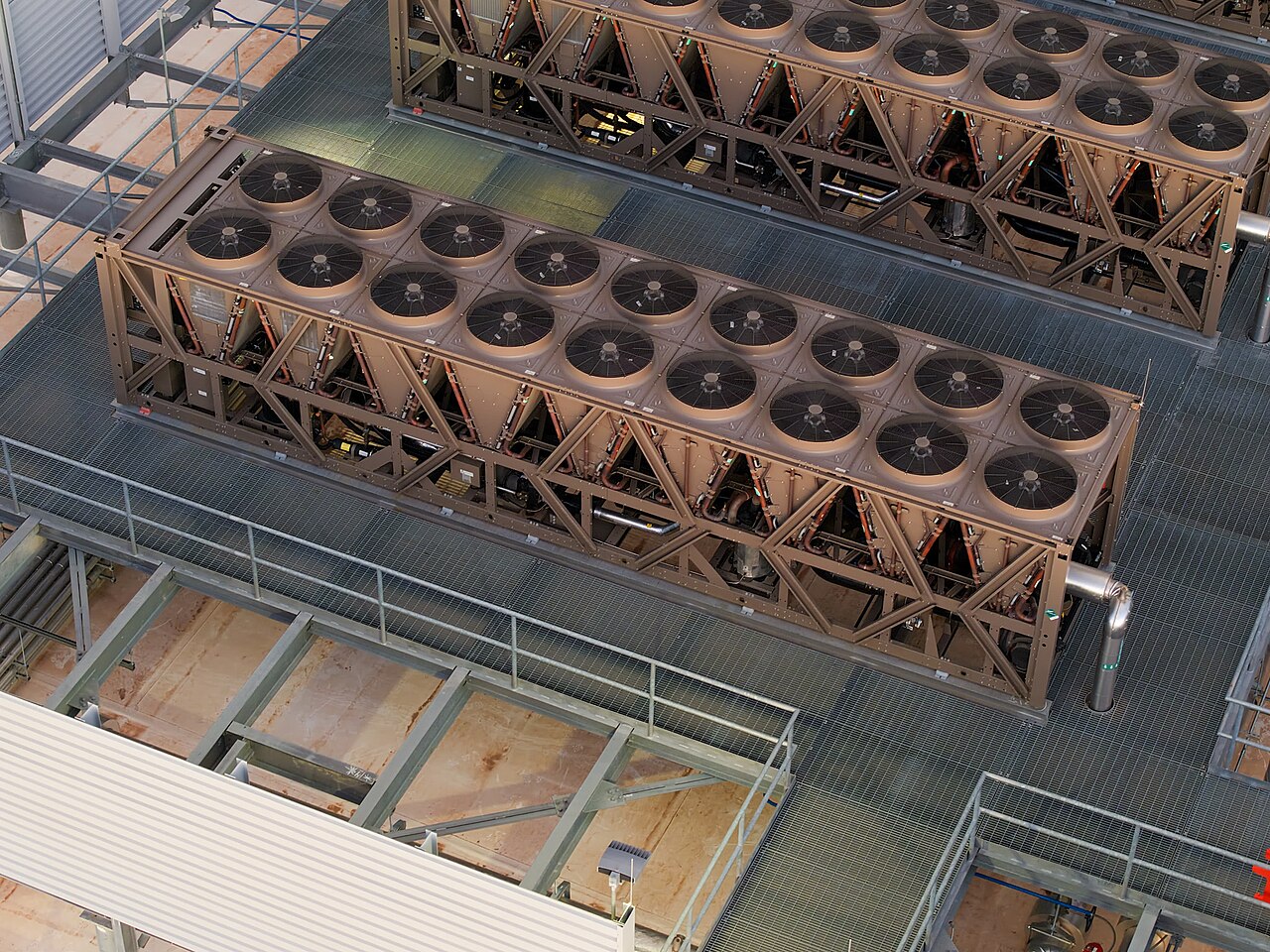
The feature image is used as an illustrative engineering photograph. It should not be interpreted as a photograph of the exact project site discussed in this article.
- Photo credit: Rsparks3 / Wikimedia Commons / CC0 1.0
- Source: Wikimedia Commons
- License: CC0 1.0 Universal

Publication Note
ATLAS should preserve the stated credit line and source/license references when publishing. License information is recorded based on the source page reviewed at the time of writing; final publication remains the publisher’s responsibility.