
Article Masthead
- Category: Capital Projects & Optimization
- Topic: PFAS Groundwater Remediation
- Region: North America
- Signal Type: Pilot Monitoring Signal
- Published Date: 2026-09-08
- Original Source Date: 2026-09-08
01 What Happened
A Department of National Defence PFAS-remediation pilot at 22 Wing North Bay has moved into its monitoring phase after colloidal activated carbon injections were completed in July. BayToday reported on September 8 that DND will monitor the groundwater system quarterly for at least one year before deciding whether the approach should be expanded.
The pilot is designed to create an in-situ adsorptive treatment zone inside the Bedrock Valley. Instead of pumping contaminated groundwater to above-ground vessels, colloidal activated carbon is injected below ground so that PFAS can adsorb as groundwater moves through the treated formation.
Federal project documents show that the pilot covers injection intervals at approximately 5–15 m below ground surface over a distance of up to 70 m. If the pilot demonstrates acceptable performance, DND’s proposed full-scale concept would extend a permeable adsorptive barrier to approximately 250 m and would be followed by long-term groundwater monitoring.
The monitoring program will examine whether the carbon was distributed effectively within the intended treatment zone and whether PFAS concentrations decline across the barrier. The federal environmental review concluded on June 30 that the proposed project was not likely to cause significant adverse environmental effects.
DND links PFAS at 22 Wing North Bay and Jack Garland Airport to historical firefighting-foam use and has reported PFAS in groundwater, surface water, soil, sediment and fish. According to DND, municipal drinking water remains within provincial criteria.
02 Key Takeaways
01 The pilot places colloidal activated carbon underground rather than relying only on pump-and-treat adsorption vessels.
02 DND will monitor performance quarterly for at least one year, focusing on carbon distribution and PFAS changes across the treatment zone.
03 A successful pilot could support a full-scale permeable adsorptive barrier approximately 250 m long.
03 Why It Matters
The technology changes where adsorption occurs. Conventional PFAS groundwater treatment often extracts water, pumps it through GAC or ion-exchange media, and then manages treated water and spent media above ground. An in-situ adsorptive barrier attempts to place sorptive capacity directly in the subsurface flow path.
That can reduce pumping infrastructure and long-term above-ground treatment, but it creates different risks. Carbon must reach the intended pore spaces and fractures. Groundwater must actually contact the treated zone. Hydraulic bypassing can reduce capture. Once sorptive capacity is consumed, replacing or regenerating material underground is much more difficult than changing media in a vessel.
PFAS composition also matters. Different compounds have different adsorption affinities and transport behavior. Short-chain PFAS may move faster through an adsorptive system than many long-chain compounds. A successful pilot therefore needs spatial and temporal evidence that the barrier is intercepting the plume as intended.
North Bay is a local site, but the engineering question is global: can activated carbon become a durable subsurface treatment zone rather than only a replaceable above-ground medium?
04 ATLAS Engineering View
From an ATLAS engineering perspective, the first performance question should be distribution, not removal percentage.
If colloidal activated carbon is unevenly distributed through a fractured or heterogeneous subsurface, high local adsorption capacity may still fail to control the plume because groundwater can bypass treated zones. Upgradient and downgradient wells, hydraulic data and concentration profiles are therefore central to interpreting the pilot.
The second issue is service life. Above-ground GAC makes breakthrough visible and media replacement straightforward. An in-situ barrier requires estimates of contaminant mass flux, competitive adsorption, carbon loading, groundwater chemistry and preferential pathways, followed by long-term monitoring.
The third issue is what activated carbon actually does. It adsorbs PFAS; it does not destroy them. That can still be an effective remediation strategy if the objective is to immobilize the plume and prevent migration, but containment and destruction should remain explicit distinctions.
If North Bay demonstrates stable hydraulic contact and sustained concentration reduction, the pilot could become an important reference for sites where continuous pump-and-treat operation is costly or impractical.
05 Sources
- BayToday — PFAS treatment injections complete at 22 Wing as monitoring begins — September 8, 2026
- Impact Assessment Agency of Canada — Installation of a Permeable Adsorptive Barrier at 22 Wing North Bay
- Impact Assessment Agency of Canada — Public Comment Period on Intent to Make a Determination — April 28, 2026
- Department of National Defence — PFAS at Jack Garland Airport and 22 Wing North Bay
Image Source and Usage Notice
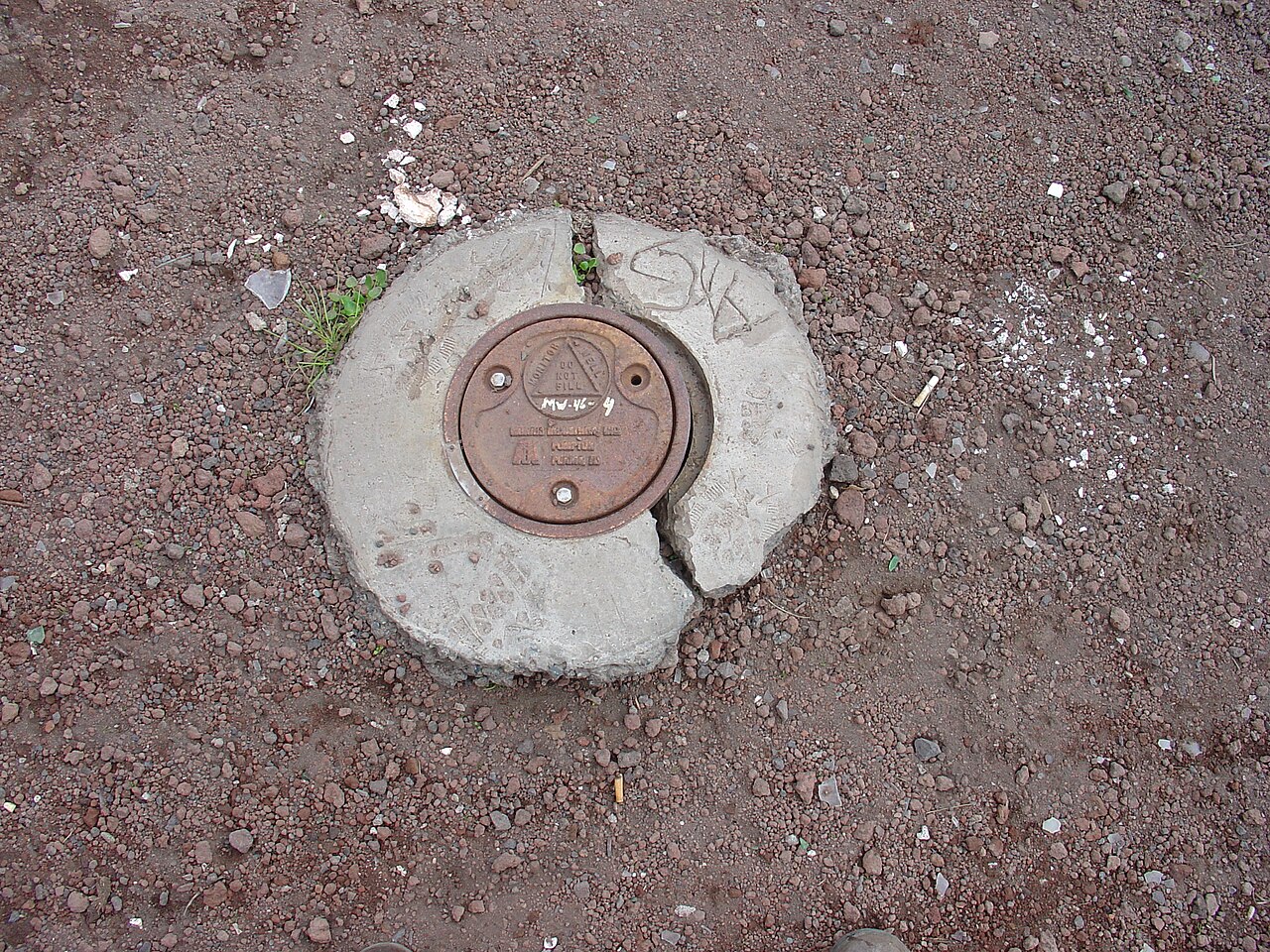
The feature image is used as an illustrative engineering photograph. It should not be interpreted as a photograph of the exact project site discussed in this article.
- Photo credit: David Winandy / NOAA / U.S. National Archives / Public Domain
- Source: Wikimedia Commons
- License: Public Domain

Publication Note
ATLAS should preserve the stated credit line and source/license references when publishing. License information is recorded based on the source page reviewed at the time of writing; final publication remains the publisher’s responsibility.